17 October 2025 | IT Tips
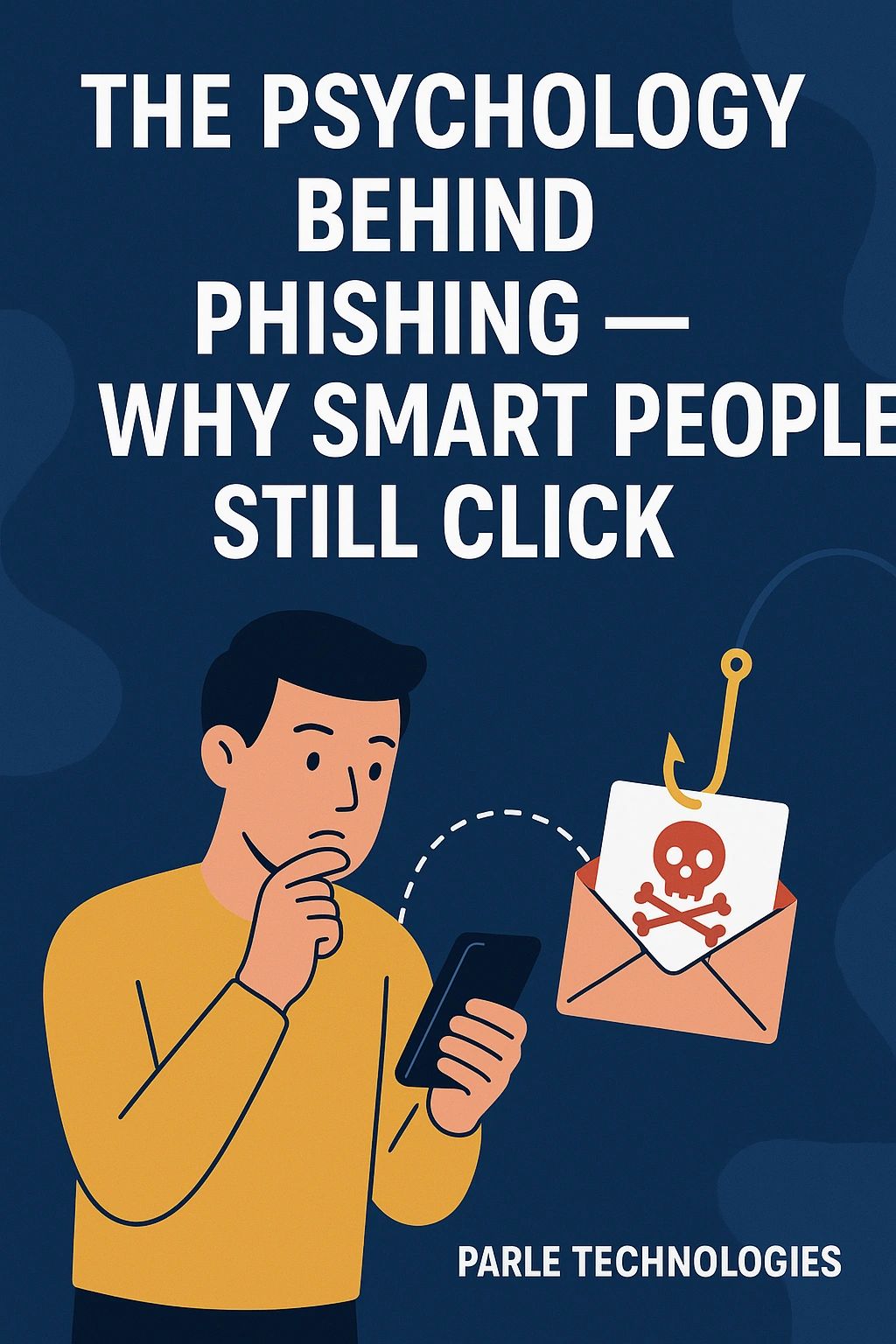
You might assume phishing tricks only work on careless or uninformed users. But that’s far from the truth. Even highly educated, tech-savvy professionals fall prey to phishing attacks—and that’s by design. In this post, we unpack the psychological levers that make phishing so effective and show how organizations can build defenses not just in technology, but in mindset and training.
(Before you dive in, don’t forget to check out our earlier post on turning employees into a human firewall: How to Turn Employees into Your Strongest Cyber Defense. Stay tuned: this builds on that foundation.)
Why “Smart” Clicks Still Happen: The Psychology of Phishing
Phishing attacks succeed not because people are ignorant, but because they appeal to basic human psychology. Below are the main cognitive biases, emotional triggers, and social dynamics that attackers exploit.
1. Emotional Urgency & Fear
Phishers often frame emails as urgent “Your account will be suspended,” “Immediate action required,” or “Security breach detected.” Faced with a perceived threat, people tend to act quickly, bypassing their internal logic or caution.
2. Authority Bias & Social Proof
When messages appear to come from known figures (a boss, HR, IT), or cite “others have done this already,” readers defer trusting authority or following perceived consensus.
Citing “Your colleague also submitted” or “We require your action” adds pressure.
3. Cognitive Overload & Decision Fatigue
In busy workdays, people juggle many tasks. A cleverly worded phishing email looks like just another business request. Under mental fatigue, critical thinking weakens.
4. Trust & Familiarity
Hackers now build phishing emails using public data (LinkedIn profiles, company news, internal jargon). The more an email “feels familiar,” the less suspicious it seems.
5. Curiosity & Reward Anticipation
“See who viewed your profile,” “Download your invoice” these clickbait-style hooks tempt us. The lure of gaining something (information, access, reward) can override caution.
6. Overconfidence & Illusion of Invulnerability
Many believe they’re “too smart” to be fooled. That confidence causes them to skip basic checks (like verifying sender domain, hovering links, or double-checking spelling).
What the Data Says: U.S. & Global Statistics
Here are some eye-opening statistics illustrating how effective phishing remains, even in sophisticated environments:
- In Q1 2025, the Anti-Phishing Working Group (APWG) recorded 1,003,924 unique phishing attacks, the highest quarterly total since late 2023.
- According to Zscaler’s ThreatLabz 2025 report, while overall phishing volume declined in the U.S. (due to stronger email authentication systems), attacks became more targeted and smarter.
- IBM X-Force reports that infostealer malware delivered via phishing emails increased by 84% year-on-year, fueling credential theft and identity-based attacks.
- Phishing is deeply linked to data breaches: in many breach investigations, a human element (error or social engineering) is involved in over 60% of cases.
These numbers show: phishing is not going away. Attackers are evolving. The human factor remains central.
How Attackers Leverage AI & Automation
Phishing is becoming smarter, faster, and harder to detect. Some key trends:
- AI (Large Language Models) generate contextually relevant, grammatically flawless phishing emails. That makes them far more believable. IBM+2knowbe4.com+2
- Attackers increasingly use QR-based phishing (“quishing”), embedding QR codes that redirect users to malicious sites, especially against users on mobile devices. arXiv
- Phishing campaigns are shifting toward hosted infrastructure on dynamic DNS or subdomain providers, making them harder to block quickly. gendigital.com
- With credentials stolen via phishing, adversaries can bypass MFA or use them in “shadow” attacks blending into normal activity. IBM
All these developments amplify the psychological leverage attackers already possess.
What Organizations Must Do: Psychological + Technical Defenses
Knowing how phishing works mentally is only half the battle. Here’s how to build resilience:
1. Design Training for Realistic Scenarios
Generic slide decks don’t cut it. Use real-life attacker tactics in simulated phishing campaigns: personalized content, urgency cues, QR codes. Use data-driven analysis (e.g., NIST Phish Scale) to calibrate difficulty. arXiv+1
2. Encourage the “Pause & Inspect” Habit
Teach people to wait and inspect. Hover links, verify senders, retype domain names. Some advanced systems insert small tasks (e.g. retyping the domain) to force users to slow down. arXiv
3. Promote Psychological Immunity
- Raise awareness about emotional triggers: urgency, authority, fear.
- Make security relatable: use internal incidents or near-misses to show how anyone could fall.
- Reward reporting: a “no blame” culture helps people report mistakes early.
4. Implement Technical Controls to Support Behavior
- Deploy phishing-resistant MFA (e.g. FIDO U2F keys)
- Use filters and AI-based email scanning
- Monitor anomalous login or credential usage
- Enforce role-based access and minimize privilege
5. Measure & Iterate
Track click rates, reporting rates, time-to-report, and compare across departments. Use the data to refine training, simulate more advanced attacks, and monitor trends.

Phishing isn’t a problem of low IQ or laziness—it’s a battle over human decision-making. Attackers win by exploiting our emotions, social instincts, and mental shortcuts. That means the defense must also live in human psychology as much as in technology.
Stay tuned for the next blog in our Human Firewall series, where we explore “Gamifying Cybersecurity Training – Does It Actually Work?” Meanwhile, dive deeper into building strong human defenses with our first post: How to Turn Employees into Your Strongest Cyber Defense.
At Parle Technologies, we don’t just deploy tools we help you build a security mindset across your organization, so your people become your strongest line of defense.
Share this post: