
22 October 2026 | IT Tips

How a Simple AI Prompt Can Become a Business Security Risk
AI is everywhere in the modern workplace.
Employees use AI to write emails, summarize documents, analyze data, create presentations, and solve everyday problems. In many cases, it takes less than 30 seconds to paste information into an AI tool and get an answer.
But what if that information was confidential?
One quick AI prompt could unintentionally expose business data.
This growing risk is known as Shadow AI when employees use AI tools that haven’t been approved or managed by their organization.
The Numbers Are Getting Attention
AI adoption is growing rapidly across U.S. workplaces.
According to Verizon’s 2026 Data Breach Investigations Report:
45%
of employees were regular AI users on corporate devices, compared with 15% the previous year.
67%
of users accessed AI services through non-corporate accounts on corporate devices.
Verizon also identified Shadow AI as an increasingly significant data-loss concern.
The takeaway: Employees are already using AI. The question is whether businesses know how and where that AI is being used.
The 30-Second Mistake
Imagine an employee receives a customer complaint.
They copy the email into an AI tool and type:
“Make this response more professional.”
It takes 30 seconds.
The response comes back perfectly.
But the original email included the customer’s name, contact information, account details, and other sensitive information.
The employee wasn’t trying to cause a security incident.
They were simply trying to work faster.
That’s the challenge with Shadow AI.
What Could Accidentally Be Shared?
Employees may unknowingly enter:
- Customer or employee information
- Confidential documents
- Financial data
- Source code
- Business contracts
- Internal emails
- Intellectual property
- Passwords or other credentials
Verizon’s 2026 research found source code was the most common type of data submitted to external generative AI models in its analyzed data-loss-prevention events.
AI Isn’t the Problem. Uncontrolled AI Is.
Businesses don’t necessarily need to ban AI.
They need to control how it is used.
IBM’s 2025 Cost of a Data Breach research found that 63% of organizations lacked AI governance policies or were still developing them. IBM also reported that organizations with high levels of Shadow AI experienced an average $670,000 higher breach cost than organizations with low or no Shadow AI.
That makes AI governance more than an IT issue.
It’s a business security issue.
5 Simple Ways to Reduce Shadow AI Risk
1. Create a Clear AI Policy
Tell employees which AI tools are approved and what information they can use with them.
2. Protect Sensitive Data
Make it clear that customer PII, passwords, financial information, source code, and confidential documents should not be entered into unapproved AI tools.
3. Use Business-Managed AI Accounts
Where possible, provide employees with approved corporate AI environments instead of relying on personal accounts.
4. Monitor Data Movement
Security and DLP tools can help identify sensitive information being transferred to unauthorized applications.
5. Train Employees
Don’t just tell employees “Don’t use AI.”
Teach them “How to use AI safely.”
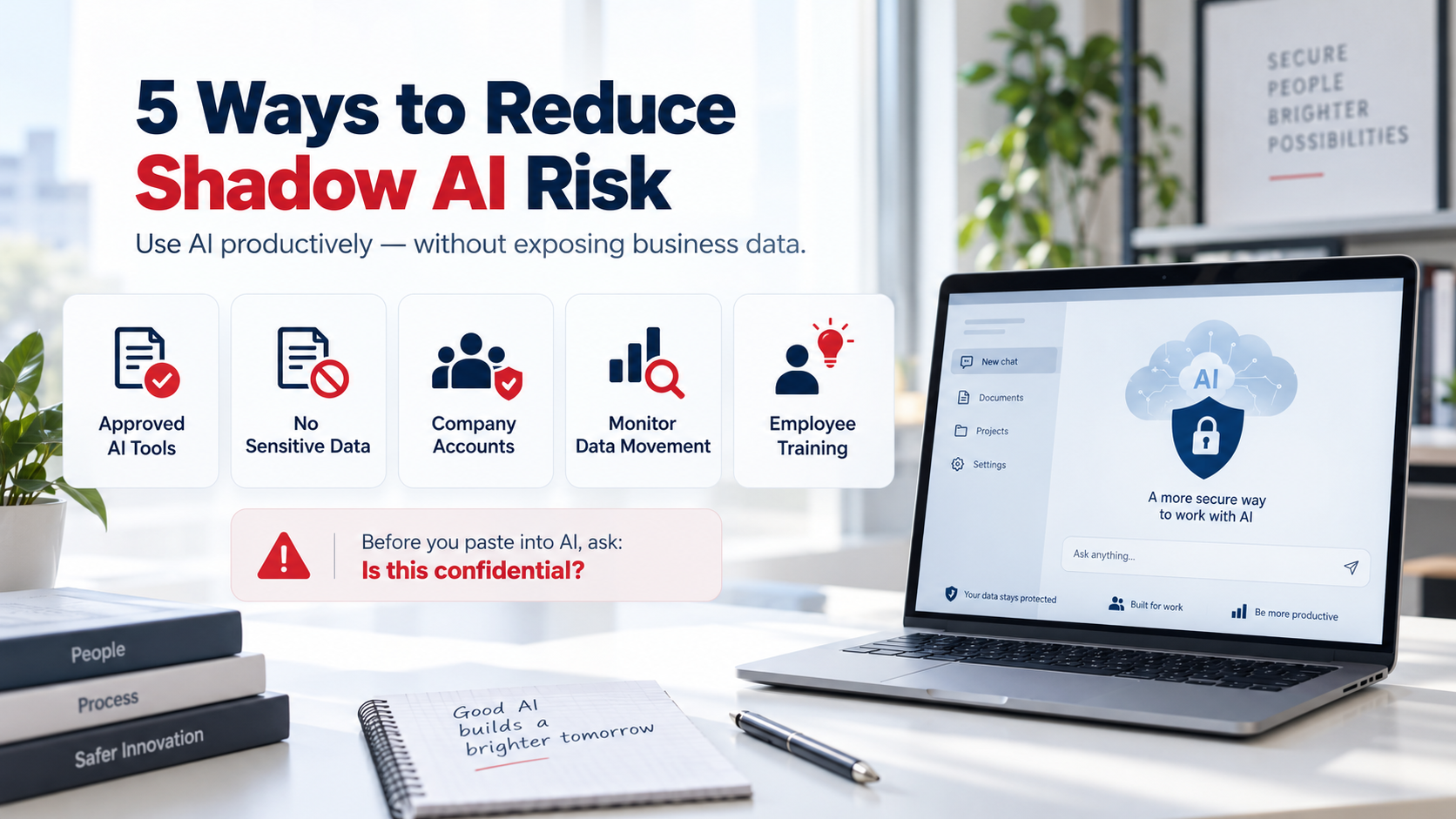
Before You Paste It Into AI, Ask:
Is this confidential?
Does it contain customer or employee information?
Does it contain source code or intellectual property?
Am I using an approved company account?
Would I be comfortable sharing this information outside the company?
If the answer raises a concern, don’t paste it.
The Bottom Line
AI can make employees more productive but productivity should never come at the cost of losing control over business data.
The goal isn’t to keep AI out of the workplace.
The goal is to make AI use secure, controlled, and responsible.
Because sometimes, 30 seconds is all it takes to make a productivity shortcut become a security problem.
Is your business ready for Shadow AI?
Website: www.parletech.com
If you are ready to secure and upgrade the IT Infrastructure of your business, Connect Now!