15 October 2026 | IT Tips
31% of Breaches Now Start With Vulnerability Exploitation
According to Verizon’s 2026 Data Breach Investigations Report, vulnerability exploitation accounted for 31% of breaches, making it the leading initial access method in the report. Verizon says this is the first time in the report’s 19-year history that vulnerability exploitation surpassed stolen credentials as the top entry point.
What this means for businesses:
An outdated firewall, VPN, application, or internet-facing system can become an open door.
Hacker’s perspective:
“What can I access without being noticed?”
Your Passwords May Be More Valuable Than Your Hardware
A hacker does not always need to break through your technology.
Sometimes, they only need to log in.
The 2025 Verizon DBIR found that credential abuse accounted for 22% of known initial access vectors, making stolen credentials one of the most common ways attackers gained entry.
Once attackers obtain legitimate credentials, they may be able to move through systems while appearing to be a normal user.
That is why MFA, strong password practices, identity monitoring, and access controls matter.
Small Businesses Are Not “Too Small” to Target
Many businesses assume hackers focus mainly on large corporations.
The data tells a different story.
Verizon’s 2026 DBIR analyzed 7,256 incidents involving small and medium-sized businesses, with 7,152 involving confirmed data disclosure. Verizon identifies system intrusion, basic web application attacks, and social engineering as the main breach patterns affecting SMBs.
The takeaway is important:
Hackers don’t necessarily need your business to be famous. They need it to be vulnerable.
Ransomware Is Still a Major Business Risk
Ransomware continues to be a major part of the threat landscape.
Verizon’s 2026 DBIR reports that ransomware was present in 48% of breaches analyzed.
For an attacker, a business with weak backups, excessive user privileges, or poorly protected endpoints can become an attractive target.
The objective may not simply be to steal information.
It can be to disrupt operations and pressure the organization to pay.
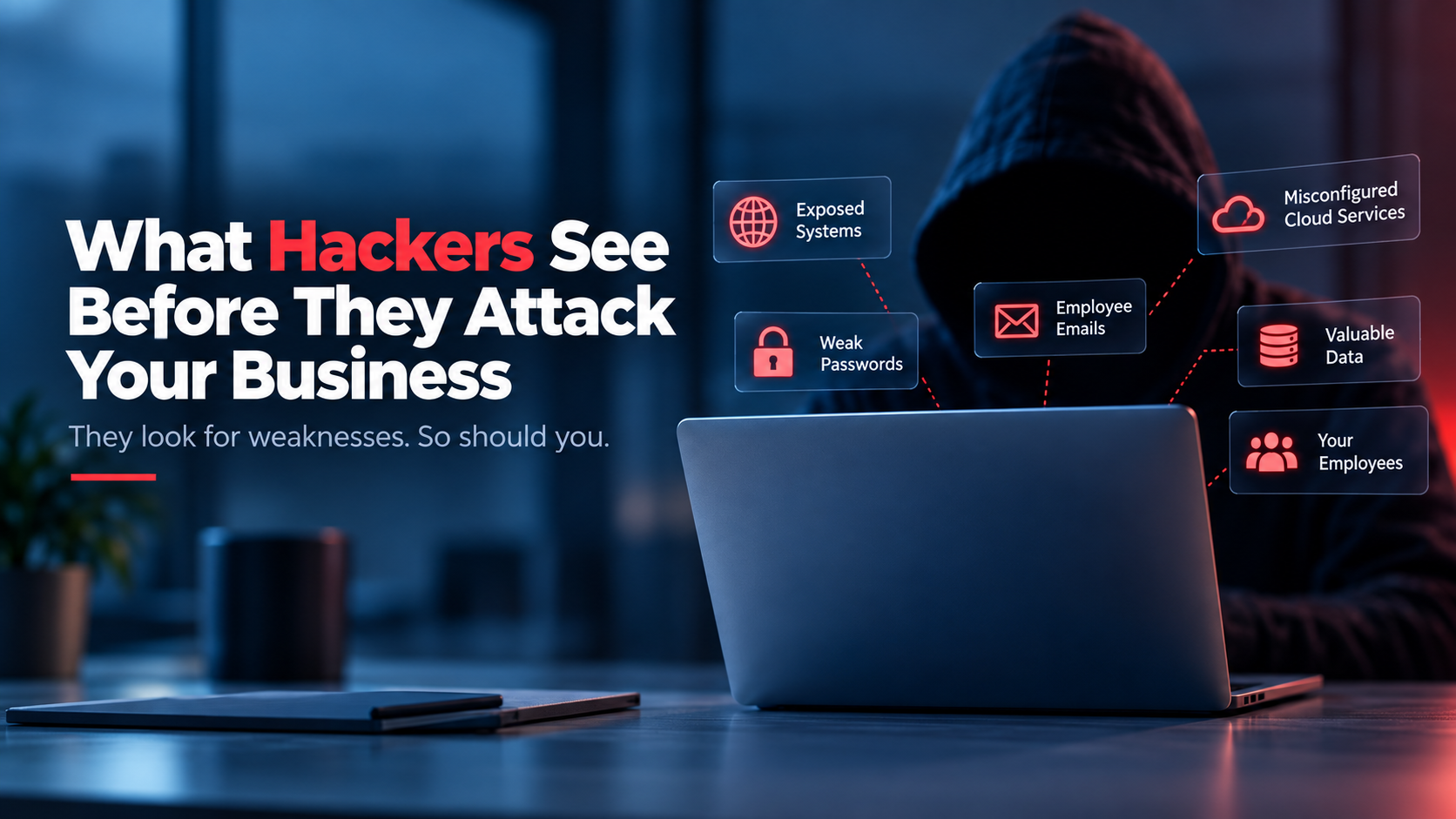
When a hacker looks at a business, they are not just looking for a computer to break into. They are looking for weak passwords, unpatched systems, exposed services, valuable data, and employees who can be tricked.
The uncomfortable truth is that attackers often do their homework before making a move.
And today, that reconnaissance can be faster and more automated than ever.
The First Thing Hackers Look For: Your Weakest Entry Point
Before launching an attack, cybercriminals may look for:
- Exposed websites and applications
- Unpatched software and VPNs
- Weak or reused passwords
- Employee email accounts
- Remote-access services
- Misconfigured cloud systems
- Valuable customer or financial data
- Employees who may respond to convincing phishing messages
- Phishing emails
- Fake login pages
- Impersonation
- Malicious text messages
- Fake support requests
- Urgent payment requests
- AI-generated messages
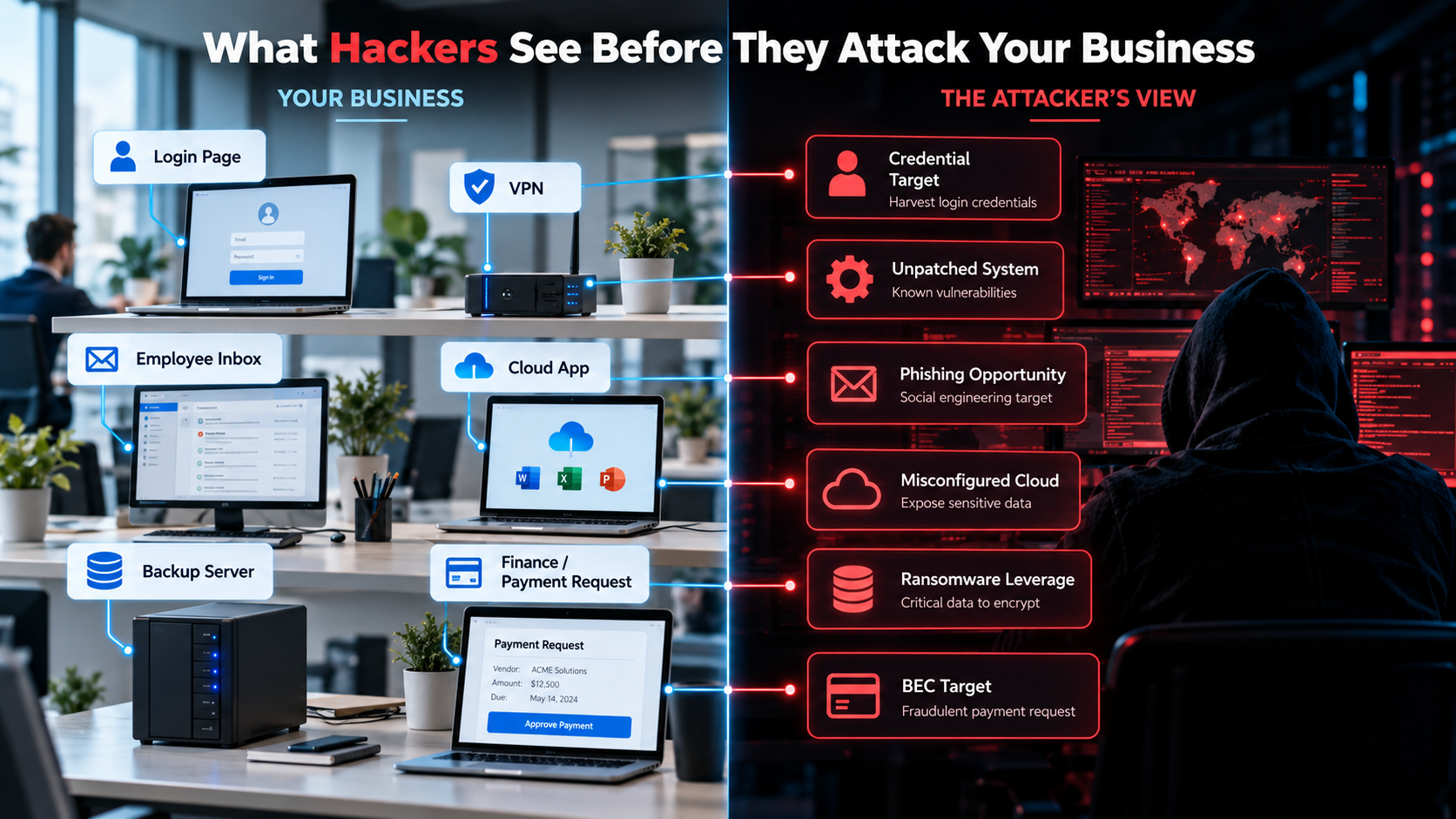
| What Your Business Sees | What an Attacker May See |
|---|---|
| A normal login page | A potential credential target |
| An old VPN | A possible entry point |
| An unused account | Another set of credentials |
| A public-facing application | An exploitable system |
| One employee with excessive access | A potential path to sensitive data |
| Unverified payment requests | A possible BEC opportunity |
| No tested backup | Greater ransomware leverage |
1. Patch internet-facing systems quickly Prioritize VPNs, firewalls, remote-access systems, applications, and other exposed technologies.
2. Protect every account with MFA Especially email, administrative, financial, and remote-access accounts.
3. Reduce unnecessary access Employees should only have access to the systems and data they actually need.
4. Monitor for suspicious activity Early detection can reduce the time an attacker has inside your environment.
5. Train employees regularly Security awareness should cover phishing, impersonation, suspicious links, payment requests, and AI-enabled scams.
6. Maintain tested backups A backup that has never been tested should not be treated as a guaranteed recovery plan.
7. Know your external attack surface Regularly identify exposed systems, outdated software, forgotten accounts, and unnecessary internet-facing services.
The Bottom Line Hackers don’t necessarily begin with sophisticated malware. They often begin with information. They look for what is exposed, what is outdated, what is poorly protected, and what can be exploited. The businesses that reduce those opportunities make it harder for attackers to turn reconnaissance into a real incident. The question isn’t whether a hacker can find your business online. The question is: What will they find when they do? Sources- Verizon, 2026 Data Breach Investigations Report
- FBI Internet Crime Complaint Center, 2025 IC3 Annual Report
- Verizon, 2025 Data Breach Investigations Report
Website: www.parletech.com
If you are ready to secure and upgrade the IT Infrastructure of your business, Connect Now!